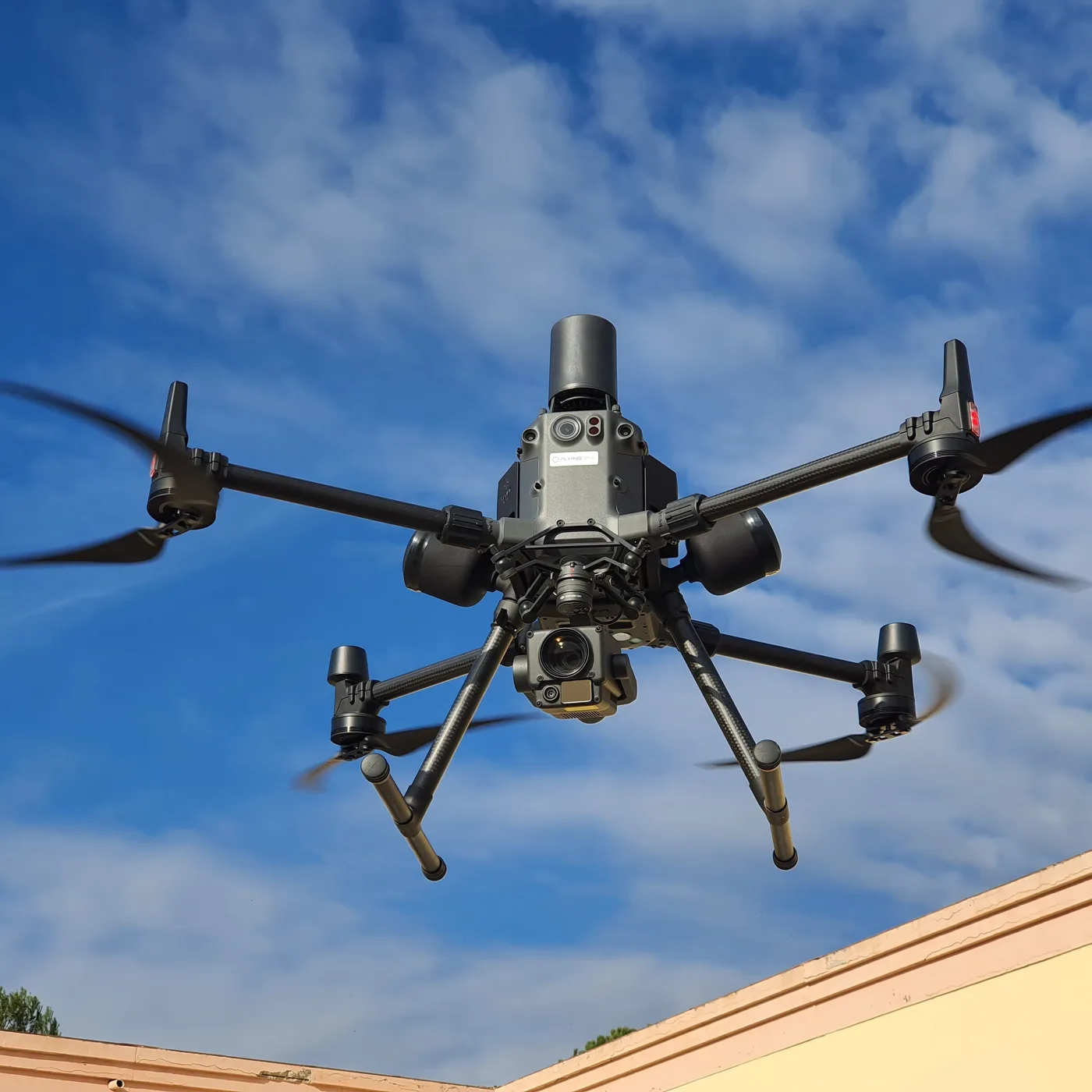

A police drone fell from 380ft into a West Bridgford road at 4.23am on 1 June after one of its arms folded in flight. Air accident investigators say nobody was hurt.
A police drone spun out of control and fell about 380 feet into a residential road in West Bridgford in June. One of its four motor arms had not been locked into place before take-off.
Nobody was hurt and no property was damaged. But the Air Accidents Investigation Branch says that if the 7.2kg drone had hit someone, “it is likely that fatal injuries could have occurred”. Its report was published on Thursday 12 November.
Overview
- What: a DJI M300 police drone crashed into a residential road in West Bridgford
- When: 4.23am on Monday 1 June 2026 (03.23 UTC in the report)
- Why: the rear right motor arm folded inwards in flight because it had not been properly installed
- Injuries: none, and no reported damage to property
- What has changed: mandatory checks of every arm lock before each flight, now shared with police forces across the country
What happened
A police team was searching for suspects in a residential area of West Bridgford, according to the AAIB report (PDF). The report does not name the force, the suspects or the road where the drone came down.
The pilot first flew a smaller Autel drone for 19 minutes. He then switched to the DJI M300 after a request to live-stream camera footage back to the control room, because streaming from the Autel had been less reliable.
The drone climbed to about 380 feet (115 metres). About four minutes into the flight, the controller showed a warning for one or two seconds:
Land promptly and check whether frame arm sleeves are tightened securely.
The pilot began flying it back to the take-off point, 355 metres away. Nine seconds later a string of errors followed, including a failure of the “propulsion system”. The drone began to spin and drop. The pilot looked up, saw it “falling”, and lost sight of it.
When its flight log ended, at about 250 feet, it was descending at 3,740 feet a minute, or about 37 knots. The AAIB says it probably went on speeding up before it hit the ground.
Wreckage was spread over about 20 metres of the road. The batteries were thrown onto the pavement next to it. The drone was damaged beyond economic repair.
Why it fell
Each of the M300’s four folding arms is held in place by a twist-to-lock collar. After the crash, three of the collars were still engaged. The rear right one was not, and part of its thread had broken off.
DJI, the manufacturer, analysed the flight data and wreckage. It concluded: “The accident was caused by the M4 [rear right] arm not being properly installed.”
The investigators found several gaps in how the flight was prepared:
- the pilot unfolded and set the arms at the start of the shift, and nothing required them to be checked again before each flight
- the pre-flight checklist did not include checking that the arms were locked
- the pilot had not signed off the checklists for this flight or the one before it, as the force’s procedures required
- his body-worn camera was switched on only after take-off, rather than before the pre-flight checks
- earlier audits had not spotted that cameras were being switched on late
The report says the pressure to get airborne quickly while searching for suspects “could inadvertently result in procedural lapses”.
Why nobody was hurt
The early hour was the main reason. The pilot reported very few vehicles on the nearby roads and no pedestrians in sight.
The AAIB says: “Had the flight taken place later in the day, when pedestrian and vehicle movements may have been expected to be higher, persons could have been fatally injured.”
It adds that the crash “again highlights the possible risk of serious injury to persons on the ground when operating UA in residential areas”. The AAIB has investigated other M300 crashes caused by arms not being fully secured, several of them involving emergency services.
What has changed since
The force that operated the drone issued a safety notice on 24 June. It found that “critical assembly and safety checks were either missed or not verified, directly contributing to the incident”. Before every M300 flight, pilots must now:
- check that the marks on each locking collar and the drone’s body line up
- hear and feel a click as each collar closes
- check that each arm does not move once locked
A second pilot or observer must also check the arms when one is available. A drone whose collar does not click, or whose thread is worn, is grounded until it is fixed.
The National Police Chiefs’ Council sent a version of that notice to every police force flying the M300, and told other public drone operators, including the National Fire Chiefs Council. It also recommended:
- a visible check of every connecting part on any drone that has to be assembled before flight
- switching body-worn cameras on before pre-flight checks start
Newer models, the M350 and M400, have sensors that stop the drone taking off if an arm is not locked. The AAIB also suggests parachutes for drones flown over towns.
What it means for you
Nottinghamshire Police regularly uses drones in searches, most recently to find a vulnerable missing man near Calverton. The AAIB report says forces in England and Wales flew 82,624 drone flights between 1 June 2025 and 31 May 2026, using more than 800 drones and 1,326 pilots. More than 30 of those drones were M300s.
The new checks are meant to stop this particular fault happening again. The AAIB’s own conclusion is that, as flights increase, “the risk of occasional lapses will likely remain”.
Have your say