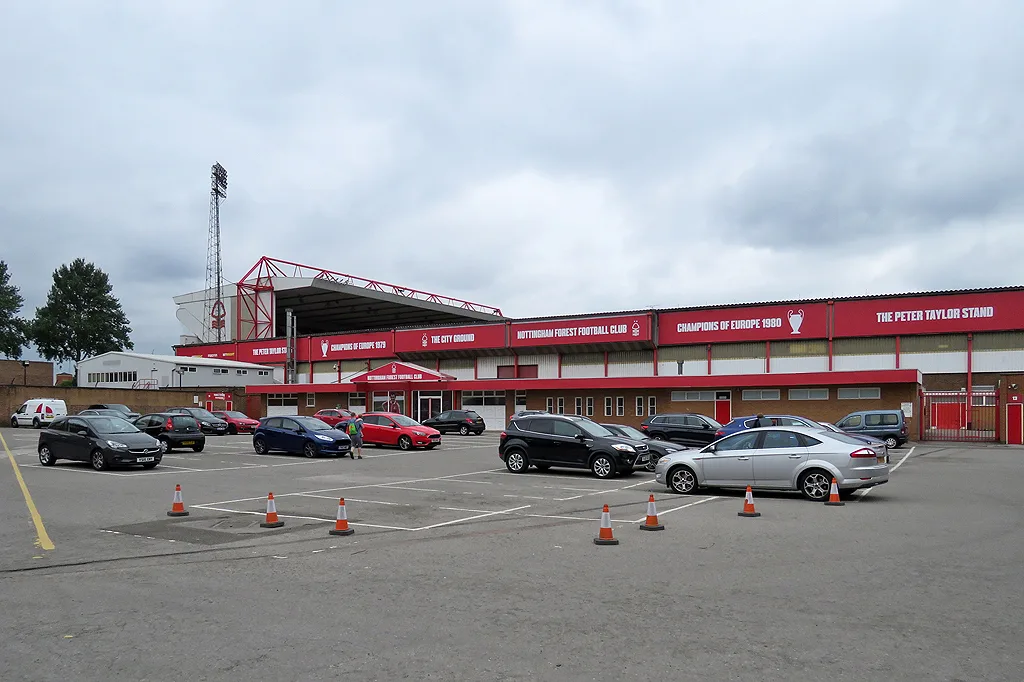

Officers recommend approving Forest's City Ground rebuild and the committee votes on 16 September. Plus Rushcliffe's 873-homes-a-year target.
Two planning stories matter in West Bridgford, and one of them has a date attached. Nottingham Forest’s applications to rebuild the City Ground go to Rushcliffe’s planning committee at 6pm on Wednesday 16 September 2026, with officers recommending approval. Behind that sits the slower and larger question of where Rushcliffe puts the 873 new homes a year the Government now requires of it, and which council will be making that decision by the end of the decade.
The City Ground: committee votes 16 September
Public comments closed on 25 August 2026. Officers now recommend that both applications be approved, subject to conditions and to a Section 106 agreement, and the committee meets on Wednesday 16 September at 6pm at Rushcliffe Arena with the two applications as its only business. Our full report on what the officers recommend, and on the river crossing and match-day parking zone attached to it, is here.
Two applications sit with Rushcliffe Borough Council for the site at Nottingham Forest Football Club, City Ground, Pavilion Road, West Bridgford, NG2 5FJ. Both were received on 16 December 2025 and both were validated on 22 July 2026, which is what started the current consultation clock.
| Reference | What it covers | Type | Status |
|---|---|---|---|
| 25/02123/FUL | Demolition of existing buildings and structures, redevelopment of the Peter Taylor Stand and the Trent End to deliver additional capacity, public realm and all associated works | Full | Committee 16 Sep 2026, recommended for approval |
| 25/02122/OUT | Redevelopment of the Brian Clough Stand to deliver additional capacity and associated works (approval for scale) | Outline | Committee 16 Sep 2026, recommended for approval |
Read together, the two applications are a phased rebuild of three of the ground’s four sides. The full application would settle the detail of the Peter Taylor Stand and the Trent End. The outline application would fix the principle and the scale of a future Brian Clough Stand without approving its detailed design, which would come back later.
Neither has been decided yet. Both are on the planning committee agenda for 16 September 2026, recommended for approval.
How this differs from the scheme already approved
This is not Forest’s first application, and confusing the two is easy.
On 26 June 2025 Rushcliffe Borough Council’s planning committee granted full permission, unanimously and subject to conditions, for a smaller scheme: demolishing the existing Peter Taylor Stand and replacing it with a 10,000-seat stand, taking the ground to about 35,000. Outline permission for a City Ground revamp had first been granted back in 2022, and the club first unveiled plans in 2019. (BBC News, 26 June 2025)
The applications now in front of the council are the more ambitious successor to that permission. Trade coverage of the December 2025 submission put the eventual target capacity at around 52,500 and the investment at more than £130 million, and reported that the documents were expanded again in July 2026 in response to points raised on crowd movement, flood safety and the public realm around the ground. Those figures come from the club and its advisers rather than from the council, so treat them as the applicant’s ambition rather than a decided outcome.
Having a say now the comment window has closed
Written comments closed on 25 August 2026. What remains is the meeting itself. The council says guidance on who may speak will be announced, and that it expects objectors, relevant ward councillors and the club as applicant. The meeting is public, at Rushcliffe Arena, and is streamed on the council’s YouTube channel.
Both applications, with all their supporting documents, are on the council’s Public Access portal, and the officer reports are attached to the committee agenda.
The bigger number: 873 homes a year
The strategic story is housing, and it is driven by a single figure.
Under the Government’s standard method, Rushcliffe’s housing requirement is 873 dwellings per annum, calculated from a base point of 1 April 2025. The council sets out the arithmetic in its own five-year housing land supply assessment:
- The baseline is 0.8% of the borough’s existing housing stock. Rushcliffe has 55,223 dwellings, so the baseline is 441.784 homes a year.
- That baseline is then adjusted for affordability. Rushcliffe’s median house price is 10.14 times median gross annual workplace earnings, using the ONS ratio for 2024 published on 24 March 2025.
- Applying the Government’s formula to that ratio gives 873.23, rounded to 873.
In other words, the borough’s housing target is roughly double what its housing stock alone would generate, and the doubling is entirely a consequence of how expensive it is to live here. Our house prices page shows what that affordability ratio looks like street by street.
Rushcliffe can currently show a 5.1-year supply
On the same assessment, the council calculates it has 5.1 years of deliverable housing land for 2025 to 2030.
| Measure | Homes |
|---|---|
| Requirement, five years at 873 a year | 4,365 |
| Requirement plus the 5% buffer | 4,583.25 |
| Deliverable supply identified | 4,676 |
| Years of supply | 5.1 |
The council applies a 5% buffer rather than 20% because the Housing Delivery Test result for the period to 31 March 2023 showed delivery at 173% of requirement, well clear of the 85% threshold that triggers the larger buffer.
That 5.1 years matters more than it looks. A council that can demonstrate five years of supply keeps control of where development goes. A council that cannot has to apply the “presumption in favour of sustainable development”, which is how sites nobody planned for get permission on appeal. Rushcliffe is 0.1 years above the line. (Rushcliffe Borough Council)
Two plans, one borough
Rushcliffe is being covered by plan-making at two levels at once, which is why the picture looks confusing.
The Greater Nottingham Strategic Plan is at examination
The Greater Nottingham Strategic Plan is a joint strategic plan covering Broxtowe, Gedling, Nottingham City and Rushcliffe. It was submitted for examination on 22 December 2025. Three planning inspectors were appointed, G Davies, U P Han and F Bradley, and the councils put forward suggested modifications in March 2026 in response to the inspectors’ questions.
Hearing sessions concluded on 23 July 2026. The inspectors are now considering their position and will issue a Post Hearings Letter setting out the next steps. No main modifications consultation has run yet. (Greater Nottingham Strategic Plan examination)
Reported figures put the plan’s provision for Rushcliffe at 11,960 homes by 2041.
A new Rushcliffe Local Plan starts in October
Separately, the borough is starting again on its own Local Plan. Cabinet agreed on 23 June 2026 to begin a new 30-month plan-making process, and the council published its Notice of Intention to Commence Local Plan Preparation on 30 June 2026.
- Preparation formally starts 31 October 2026.
- The plan must be adopted by 30 April 2029.
- It will replace both the existing Local Plan Part 1 and Part 2.
The council’s own description is that the new plan will guide new homes, employment, infrastructure, environmental protection and design standards across the borough, and that it supersedes both existing documents. (Rushcliffe Borough Council)
The constraint on it is the 873 figure above. A local plan that plans for less than the Government’s assessed need is not found sound at examination, so the argument in Rushcliffe over the next three years will be about where the homes go, not how many.
If a site near you is allocated in either plan, that does not mean a development is approved. It means the principle of building there has been judged acceptable in policy, which makes a later detailed application much harder to refuse. The plan stage is the point to engage, not the moment an application lands.
And the council itself is being abolished
One more thing sits behind all of this. On 16 July 2026 the Government confirmed it would implement Nottingham City Council’s local government reorganisation proposal, replacing the nine existing councils in Nottingham and Nottinghamshire with two unitary authorities.
- One will cover Nottingham City plus parts of Broxtowe, Gedling and Rushcliffe.
- The other will cover Ashfield, Bassetlaw, Mansfield, Newark and Sherwood, plus the remaining parts of Broxtowe, Gedling and Rushcliffe.
- That timetable is paused. On 7 September 2026 the Government put Nottingham and Nottinghamshire into a review of the whole reorganisation programme, told councils to stop implementation work, and confirmed the 6 May 2027 borough election goes ahead on existing boundaries. See what the pause changes.
- Parliamentary approval is still required, and services continue unchanged in the meantime.
The practical consequence for planning is that the Rushcliffe Local Plan due for adoption by April 2029 will be adopted by a council that will no longer exist, or finished by whichever successor authority inherits the work. Residents can check which of the two new councils their postcode will fall into at lgrnotts.org.
Frequently asked questions
What are the current planning applications for the City Ground?
Two: 25/02123/FUL, a full application to demolish existing structures and redevelop the Peter Taylor Stand and Trent End, and 25/02122/OUT, an outline application for the scale of a redeveloped Brian Clough Stand. Both were received on 16 December 2025, validated on 22 July 2026, and go to the planning committee on Wednesday 16 September 2026, recommended for approval.
Has the City Ground expansion already been approved?
A smaller scheme has. On 26 June 2025 Rushcliffe’s planning committee unanimously approved a 10,000-seat replacement for the Peter Taylor Stand, taking capacity to about 35,000. The applications now before the council are a larger, later proposal and have not been decided.
How many new homes does Rushcliffe have to build?
873 a year under the Government’s standard method, from a base date of 1 April 2025. Over five years that is 4,365 homes, or 4,583 including the 5% buffer.
Does Rushcliffe have a five-year housing land supply?
Yes, but only just. The council’s 2025 assessment identifies 4,676 deliverable homes against a 4,583 requirement, giving 5.1 years.
When is the new Rushcliffe Local Plan due?
Preparation formally starts on 31 October 2026 and the plan must be adopted by 30 April 2029. It will replace the existing Local Plan Parts 1 and 2.
What is happening with the Greater Nottingham Strategic Plan?
It was submitted for examination on 22 December 2025 and hearing sessions finished on 23 July 2026. The inspectors will issue a Post Hearings Letter setting out what happens next. It covers Broxtowe, Gedling, Nottingham City and Rushcliffe.
Will Rushcliffe Borough Council still exist?
That was going to change on 1 April 2028, but the timetable was paused on 7 September 2026 and no new date exists. The Government confirmed on 16 July 2026 that Nottingham and Nottinghamshire would move to two unitary councils, with West Bridgford’s part of Rushcliffe going into the Nottingham-based authority. Elections are planned for May 2027.
Related
- West Bridgford house prices: the affordability ratio behind the 873-homes target, and what each part of the borough sells for.
- West Bridgford roadworks and travel: the A52 junction rebuild that will run alongside all of this.
- Things to do in West Bridgford, including how to get inside the City Ground when there is no match on.
Sources
- Rushcliffe Borough Council Public Access portal, applications 25/02123/FUL and 25/02122/OUT, for the descriptions, dates and consultation deadline.
- BBC News, Forest stadium expansion given green light, 26 June 2025 and Forest stadium revamp recommended for approval, 18 June 2025 for the earlier permission.
- Rushcliffe Borough Council five year housing land supply assessment 2025 for the 873 figure, the calculation, the 5% buffer and the 5.1 years.
- Greater Nottingham Strategic Plan examination for the submission date, inspectors and hearing dates.
- Rushcliffe Borough Council, new Rushcliffe Local Plan for the plan timetable and the Notice of Intention date.
- Rushcliffe Borough Council, local government reorganisation decision announcement and lgrnotts.org for the two-unitary decision and timetable.
Planning applications move. Check the reference on the council’s Public Access portal before relying on a date or a status on this page.
Have your say